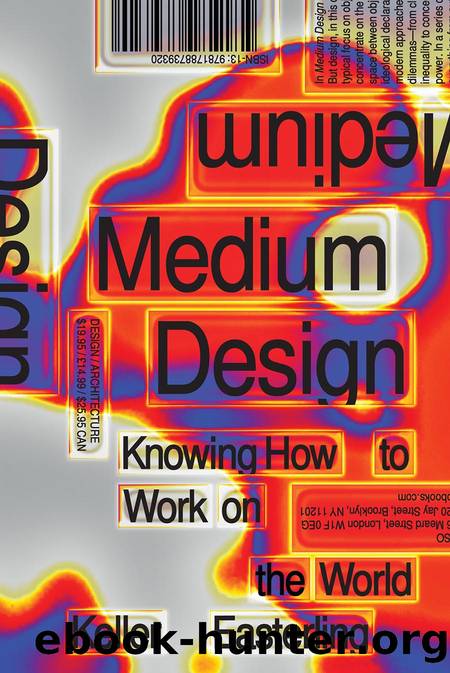
Medium Design: Knowing How to Work on the World by Keller Easterling
Author:Keller Easterling
Language: eng
Format: epub
Publisher: Verso
4.
Since persuasions about autonomy and freedom in transportation are deeply ingrained, designing the cultural narratives that accompany the entanglements of switching may be especially important. But in a world that largely relies on visual evidence, how do you communicate the activities of a differential or a switch that resists representation? And in a contemporary culture that associates innovation with new digital technologies, products, and software platforms to be packaged in start-up clichés, how does medium design demonstrate that a spatial relationship is the innovative invention?
Some visions of the new mobility landscape are remarkably anachronistic. Emotional music accompanies an ad for a Renault concept car called SYMBIOZ: four people ride facing one another in an AV that is the family car. They are having fun. There is a passionate kiss between a man and woman in the car, but there is also a teenage girl and a younger brother. The AV is all alone on a wooded road that eventually becomes the driveway to their secluded modernist mansion. The car enters the house, doors open, and, with the ease that attends privilege, the four pile into the house. The teenager transfers her phone-watching from a seat in the car to a seat on the couch in the spectacular house. Meanwhile, the car ascends in a car elevator to be displayed on the roof as the camera pans up to an aerial view of the house in a green clearing surrounded by forest.20
Elon Muskâinventor of PayPal, Tesla electric cars, SolarCity, SpaceX, and Hyperloopâis transparent about his storytelling. A recent SpaceX launch sent into orbit a cherry red Tesla Roadster convertible driven by a space-suited mannequin with the radio playing David Bowieâs âSpace Oddityâ because, as Musk says, âsilly and fun things are important.â21
Hyperloop, like another flying car solution to congestion, proposes to shoot pods of freight or passengers at supersonic speeds on a cushion of air in an underground tube. It is projected as a link between Los Angeles and San Francisco, even while a high-speed rail project is underway between the two cities. The first underground tube, dug by a company that Musk named âthe Boring Company,â is already deemed to be slow, even with test cars, and it would be impossibly congested in regular traffic. But, with start-up swagger, Musk describes the project as a way to ârevolutionize cities and get rid of soul-destroying traffic.â22
Other narratives circulating in the transportation landscape are more insidious. Using the old superbug trick of co-opting and inverting an ideological message, oil company lobbies in the United States often oppose funding for transit, perversely spinning it as an unaffordable luxury of big government. Automated vehicles alone are the future of transportation, they argue, as they look for their own big-government funding to repair a crumbling highway network. In a stunning example of the trick, the oil billionaire Koch brothers funded a group called Americans for Prosperity, who likened light rail to the âdiamond-encrusted Rolex watchâ of transportation.23
Against all odds, superbugs can maintain an audience for these tired persuasions.
Download
This site does not store any files on its server. We only index and link to content provided by other sites. Please contact the content providers to delete copyright contents if any and email us, we'll remove relevant links or contents immediately.
Kathy Andrews Collection by Kathy Andrews(11772)
The remains of the day by Kazuo Ishiguro(8906)
Spare by Prince Harry The Duke of Sussex(5150)
Paper Towns by Green John(5148)
The Body: A Guide for Occupants by Bill Bryson(5044)
Industrial Automation from Scratch: A hands-on guide to using sensors, actuators, PLCs, HMIs, and SCADA to automate industrial processes by Olushola Akande(5028)
Machine Learning at Scale with H2O by Gregory Keys | David Whiting(4268)
Be in a Treehouse by Pete Nelson(4005)
Never by Ken Follett(3892)
Harry Potter and the Goblet Of Fire by J.K. Rowling(3818)
Goodbye Paradise(3778)
The Remains of the Day by Kazuo Ishiguro(3359)
Into Thin Air by Jon Krakauer(3355)
Fairy Tale by Stephen King(3316)
The Cellar by Natasha Preston(3301)
The Genius of Japanese Carpentry by Azby Brown(3265)
120 Days of Sodom by Marquis de Sade(3234)
The Man Who Died Twice by Richard Osman(3047)
Drawing Shortcuts: Developing Quick Drawing Skills Using Today's Technology by Leggitt Jim(3045)
